

Goods Classification and Commodity Code Support UK
Understanding Commodity Codes
Goods classification is the process of assigning the correct commodity code to products being imported into or exported from the UK. Every commercial shipment needs one. The code tells customs authorities what the product is, determines the duty rate, identifies whether licences are required, and affects how goods are treated at the border.
Getting it wrong isn't just an administrative issue. It can mean overpaying duty, missing a licence requirement, or triggering an HMRC audit that looks back across years of declarations. GEIM helps UK businesses identify and verify the correct commodity codes before goods move, so declarations are accurate from the start.



What is Goods Classification in UK Customs?
Goods classification means assigning each product a code from the UK Trade Tariff, using the international Harmonised System as its foundation. In the UK, commodity codes are ten digits for imports and eight digits for exports. Each digit narrows the product category further until the code identifies the specific type of goods being declared.
The code isn't just a reference number. It's the mechanism through which customs authorities work out duty rates, VAT treatment, whether anti-dumping measures apply, whether goods qualify under trade agreements, and whether any licences or certificates are required.
Without the correct commodity code, a customs declaration can't be completed accurately. And an inaccurate declaration creates real risk for the business responsible for submitting it.
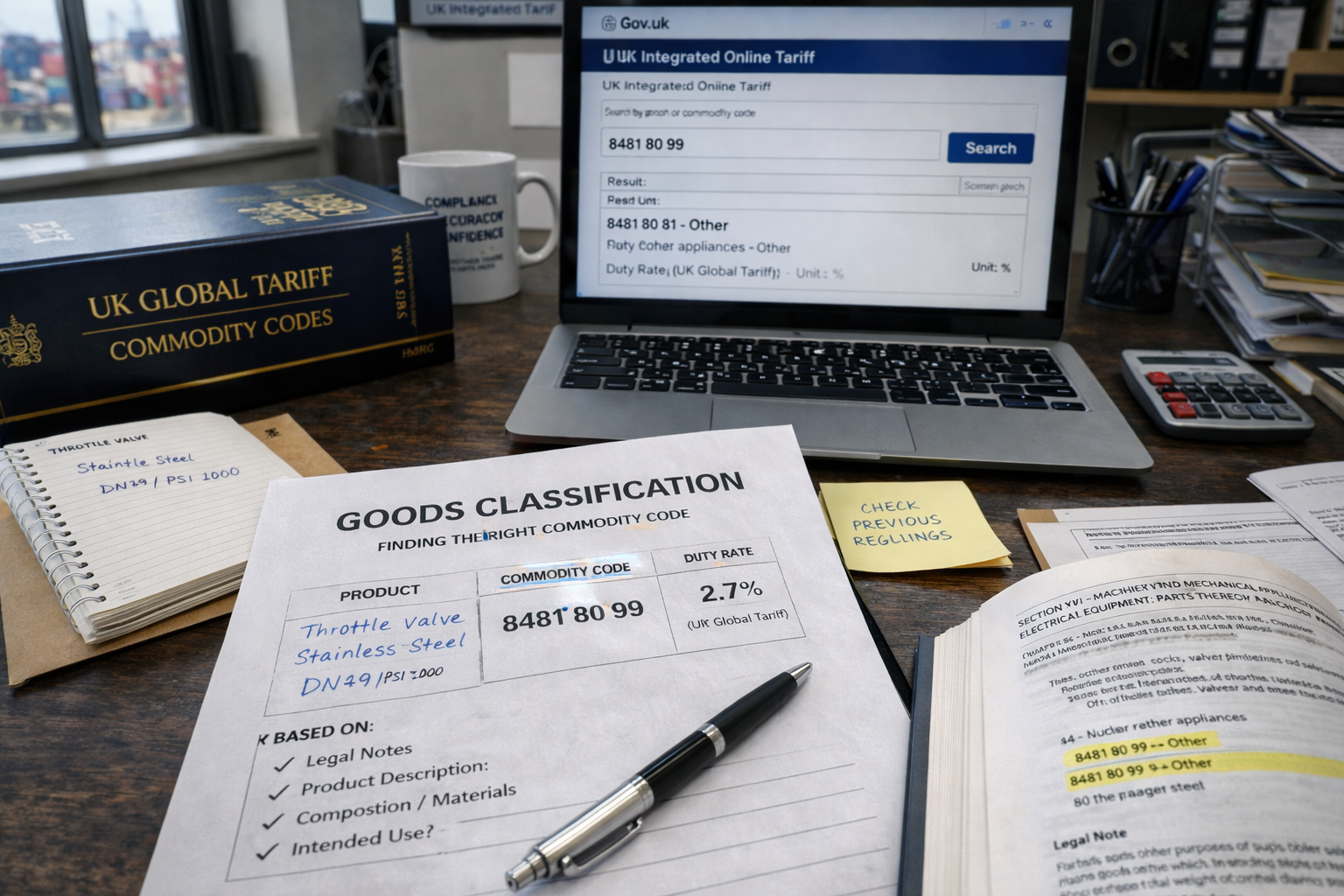
How Goods Classification Works for UK Imports and Exports
Classification starts with the Harmonised System, a global framework of product groups maintained by the World Customs Organisation. The UK Trade Tariff builds on this, adding further subdivisions specific to UK duty rates, trade policy, and licensing requirements.
In practice, finding the right code means working through the tariff systematically. You start with the broad product category, narrow by material or function, then narrow further by technical characteristics until you reach the correct code. For some products this is straightforward. For others it requires careful reading of tariff legal notes and classification rules that don't always match commercial logic.
That's where mistakes happen. Classification isn't simply a matter of finding the most plausible-sounding description. Customs law applies specific rules about how goods must be classified, and those rules sometimes produce codes that differ from what a product catalogue or invoice would suggest. It's one of the reasons businesses come to GEIM rather than working through the tariff alone.
Responsibility for correct classification sits with the importer or exporter, not the freight forwarder or shipping agent. Where a classification error leads to a duty underpayment, HMRC can pursue recovery from the declarant, along with interest and penalties. The cost of getting it wrong is almost always higher than the cost of getting it right first time.
- Customs duty.: Different codes carry different duty rates. Misclassification can mean overpaying, underpaying, or receiving a retrospective demand from HMRC.
- Import VAT.: Certain codes attract reduced or zero VAT rates.
- Licences and controls.: Some codes trigger licence requirements. Goods declared under the wrong code can clear customs and be identified as non-compliant later.
- Trade agreement eligibility.: Preferential duty rates under trade agreements apply at commodity code level.
- Anti-dumping measures.: Some imports from specific countries attract additional duties at commodity code level.
- CBAM obligations.: The UK Carbon Border Adjustment Mechanism applies to specific commodity codes.

Why Commodity Codes Matter for UK Imports and Exports
Classification affects far more than duty rates. The commodity code assigned to a product can determine all of the following.
- Customs duty. Different codes carry different duty rates. Misclassification can mean overpaying, underpaying, or receiving a retrospective demand from HMRC.
- Import VAT. Certain codes attract reduced or zero VAT rates. Classification determines which rate applies at the point of import.
- Licences and controls. Some codes trigger licence requirements. Goods declared under the wrong code can clear customs and be identified as non-compliant later, which is harder to resolve.
- Trade agreement eligibility. Preferential duty rates under trade agreements apply at commodity code level. An incorrect code can mean paying duty that didn't need to be paid.
- Anti-dumping measures. Some imports from specific countries attract additional duties at commodity code level. Incorrect classification can expose importers to unexpected charges.
- CBAM obligations. The UK Carbon Border Adjustment Mechanism applies to specific commodity codes. Accurate classification is a prerequisite for assessing CBAM reporting liability. See our CBAM page.
The HMRC Audit Risk Most Businesses Don't Consider
HMRC can conduct retrospective audits covering up to three years of customs declarations. If incorrect commodity codes are identified during that audit, duty can be recovered on every affected shipment across the entire period, not just the most recent one.
For a business importing regularly, that exposure adds up quickly. HMRC can also issue penalties of up to £2,500 per contravention for inaccurate declarations, alongside interest on unpaid duty.
Classification errors that feel like small administrative mistakes in the moment can become significant financial liabilities when they're identified retrospectively. Getting codes right consistently, and reviewing them periodically, is considerably less costly than correcting them under audit conditions. GEIM works with businesses on both initial classification and ongoing review, so the exposure doesn't quietly build.
- Machinery with multiple functions
- Electronic components and products
- Food products with mixed ingredients
- Industrial parts and assemblies
- Textiles with blended materials
- Products sold as kits or sets
- Goods at manufacturing stage boundaries
- Products with more than one possible use
Got a product that's hard to classify? We can work through it
Why Classification Mistakes Happen So Often
Many products don't fit neatly into one obvious tariff description. Classification often turns on details that aren't visible from a commercial invoice or product catalogue.
It can depend on material composition, manufacturing stage, technical function, or the specific use the goods are put to. Two products that look commercially identical can sit under entirely different tariff codes depending on how customs law interprets them.
Classification questions come up most often with:
- Machinery with multiple functions
- Electronic components and products
- Food products with mixed ingredients
- Industrial parts and assemblies
- Textiles with blended materials
- Products sold as kits or sets
- Goods at manufacturing stage boundaries
- Products with more than one possible use
Relying on a supplier's description, a previous shipment's code, or a best guess creates avoidable risk. It's a reasonable starting point but it isn't the same as confirmed classification. If you're unsure, GEIM can review the product and confirm the correct code before goods move.
Advance Tariff Rulings: legally binding classification certainty
If you need certainty about the correct commodity code for a product before it moves, you can apply to HMRC for an Advance Tariff Ruling (ATR). An ATR is a legally binding decision on how a specific product must be classified under the UK Trade Tariff.
Once issued, it means HMRC can't reclassify the goods at the border or challenge the code retrospectively, provided the product and the circumstances haven't changed. For businesses importing high-value goods, regulated products, or products close to classification boundaries, an ATR removes the guesswork entirely.
ATR applications are submitted to HMRC with a detailed product description and supporting technical documentation. Processing times vary. GEIM can advise on whether an ATR is the right approach for your product and help prepare the application.
Goods Classification for Imports and Exports
Classification for imports into the UK For imports into the UK, the commodity code determines the duty rate, VAT treatment, whether duty relief schemes apply, whether quotas affect the shipment, and whether licences are required before goods can be released.
An incorrect code on import can lead to overpayment, underpayment, customs challenges, or a retrospective correction request. GEIM verifies classification before declarations are submitted so none of that happens unnecessarily.
Classification for exports from the UK
For exports from the UK, classification matters even where duty isn't the immediate concern. Commodity codes influence export declarations, export controls, licensing obligations, destination customs treatment, and rules of origin requirements under trade agreements.
A product incorrectly classified on export can create issues at UK departure and when goods arrive in the destination country. Both problems are avoidable with correct classification at the outset. GEIM handles export classification as part of our export customs clearance service, so the declaration is right before goods leave.
Mixed and complex consignments
Shipments containing multiple product types, composite goods, or items at classification boundaries need particular care. Each product within a consignment must be classified correctly. Where goods are sold together as a set, tariff rules about composite goods may also affect how the whole consignment is classified.
Periodic review for regular shippers
Tariff codes and their interpretations change. A code that was correct when a product was first imported may no longer be accurate following tariff updates or changes to the goods themselves. For businesses shipping the same products regularly, periodic review reduces the risk of accumulated errors building up across a large number of declarations. GEIM offers classification review for businesses who want confidence that their codes are still correct, not just that they were correct when first applied.
- A product has changed in composition or manufacturing and the existing code may no longer apply
- Goods have been flagged or queried by customs at the border
- An HMRC audit is underway or anticipated
- Applying for duty relief schemes where correct classification is a condition of eligibility
- Assessing CBAM reporting obligations for goods that may fall within scope
- Expanding into new export markets where destination customs rules differ
- Reviewing a supply chain where codes haven't been verified in some time

When to Get Classification Support
The most common situation is importing or exporting a product for the first time and not being certain of the code. But there are several other situations where classification support makes a real difference.
- A product has changed in composition or manufacturing and the existing code may no longer apply
- Goods have been flagged or queried by customs at the border
- An HMRC audit is underway or anticipated
- Applying for duty relief schemes where correct classification is a condition of eligibility
- Assessing CBAM reporting obligations for goods that may fall within scope
- Expanding into new export markets where destination customs rules differ
- Reviewing a supply chain where codes haven't been verified in some time
Once goods are moving, classification decisions are harder to correct without operational consequences. A reclassification at the border affects delivery commitments, freight planning, and landed cost expectations. GEIM can step in at any point, but it's much easier to resolve classification before goods enter the customs process than after.
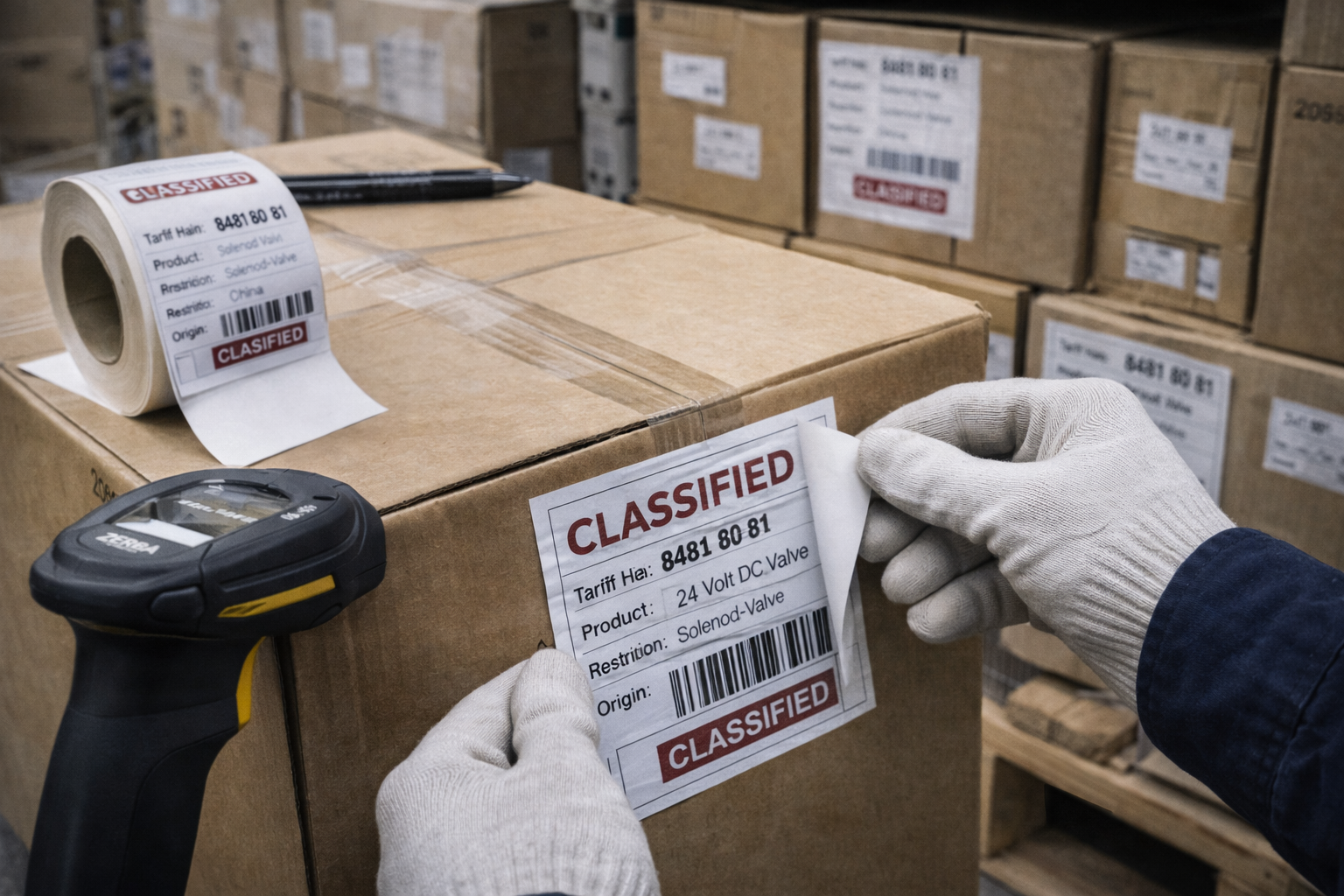
Getting goods classification right matters more than most businesses realise
Most classification errors don't come from carelessness. They come from products that genuinely sit in an uncertain part of the tariff, codes that haven't been revisited since they were first applied, or supplier descriptions that don't map cleanly onto customs categories.
Some businesses come to us with a single product they've never imported before and want to get right first time. Others come after a customs query or following advice that their current codes need a second look. A few come to us during an HMRC audit, which is the most stressful point to be reviewing classification and the most important time to have expert support.
Whatever the situation, the goal is the same: confirm the right code before declarations are submitted, document the reasoning, and reduce the exposure that comes from classification uncertainty. If you're not confident your commodity codes are correct, it's worth checking before the question gets asked for you.
Get in touch with GEIM and we can talk through your products and what classification support makes sense.
Frequently asked questions
A commodity code is a numerical code assigned to goods being imported into or exported from the UK. It's taken from the UK Trade Tariff, which is built on the international Harmonised System. The code tells customs authorities what the product is and determines the duty rate, VAT treatment, licence requirements, and any other controls that apply. UK import codes are ten digits; export codes are eight digits.
Using the wrong commodity code can result in duty being paid at the wrong rate, goods being held at the border, a correction request from HMRC, or penalties of up to £2,500 per contravention for inaccurate declarations.
Where the error leads to a duty underpayment, HMRC can recover the outstanding amount along with interest. HMRC can also audit up to three years of declarations retrospectively, meaning a classification error that's repeated across multiple shipments can become a significant liability. Responsibility for correct classification sits with the importer or exporter, not the freight forwarder.
Commodity codes are found by working through the UK Trade Tariff on GOV.UK. The tariff is structured hierarchically: you start with the broad product category and narrow down through successive subdivisions until you reach the correct code.
For straightforward products this is manageable. For composite goods, machinery with multiple functions, or products at classification boundaries, the correct code often requires careful interpretation of tariff legal notes and classification rules. Where there's genuine uncertainty, it's worth getting classification confirmed before submitting a declaration rather than after goods have moved.
The importer or exporter is legally responsible for correct classification. This responsibility doesn't transfer to a freight forwarder, shipping agent, or customs broker simply because they submitted the declaration.
Where a customs broker submits a declaration on behalf of a business, the business remains liable for the accuracy of the information provided. This is why verifying classification before declarations are submitted matters, rather than relying on a previous shipment's code or a supplier's suggestion.
An Advance Tariff Ruling (ATR) is a legally binding decision from HMRC on how a specific product must be classified under the UK Trade Tariff. Once issued, HMRC can't reclassify the goods at the border or challenge the code retrospectively, as long as the product and circumstances haven't changed.
An ATR is worth considering for high-value goods, regulated products, products that sit close to a classification boundary, or any situation where ongoing certainty about the code matters commercially. GEIM can advise on whether an ATR is the right approach and help prepare the application.
Yes. HMRC can conduct retrospective audits covering up to three years of customs declarations. If incorrect commodity codes are identified, duty can be recovered on every affected shipment across that period, alongside interest and penalties.
For businesses importing regularly, three years of declarations at an incorrect duty rate can represent a significant liability. Reviewing classification periodically and keeping documentation of the reasoning behind codes is the most effective way to reduce that exposure.
Yes. The UK Trade Tariff is updated regularly. Codes can change following scheduled tariff reviews, reclassification decisions, changes to UK trade policy, or updates to the underlying Harmonised System at international level.
A code that was correct at the time of a product's first import may no longer be accurate. For businesses shipping the same products regularly, periodic review is advisable to make sure declarations stay accurate over time.
An HS code refers to the Harmonised System, the international classification framework maintained by the World Customs Organisation. HS codes are six digits and used globally.
A commodity code in the UK context extends the HS code with additional digits: ten digits for imports and eight for exports. These extra digits reflect UK-specific duty rates, licensing requirements, and trade policy. The HS code forms the first six digits of a UK commodity code.
Yes. We support businesses with commodity code classification for both UK imports and UK exports. Whether you need classification confirmed for a single product, a mixed consignment, or want a review of existing codes, we can help before declarations are submitted.
If you're not confident your current codes are correct, or you're importing a product for the first time, get in touch before goods move. It's considerably easier to confirm the right code in advance than to correct it after a declaration has been submitted.